

 Blackjack games have long been favorites among casino patrons and players who host home games for family and friends. But it’s the recent appearance of online games that has given rise to its current popularity.
If you already know the game’s rules and just want to get started, check out our online casino reviews page for the best places to play. If you need more instructions and/or strategy, read our comprehensive game guide. Simply click on the below links to learn more about the subject you’re interested in. They’ll take you to pages that cover everything from basic game rules to advanced tips and strategy. Good luck!










Online Blackjack Rules
Playing online blackjack is nearly the same as playing in brick and mortar and casinos. You place your bet before the cards are dealt and face off with the dealer in every hand. Card values, hand rankings and betting structures are the same and players may “Double Down”, “Split” bets and purchase insurance. Read our rules article to familiarize yourself with the game and learn about its unique aspects.
It’s fairly simple to learn how to play blackjack. However, to really master it requires time, practice and a good teacher, which is where Gambling City’s Online Blackjack Guide comes in. The regulations provided here include both basic and advanced blackjack rules and strategies. After reading them, practice blackjack online with our free internet blackjack game. Play blackjack risk-free and hone your newly acquired skills.
The object of the game is to get a better total score than the dealer. To do this, players aim for a score of or as near to 21 as possible without exceeding 21. If you exceed 21 you “bust” and lose your bet. When you are satisfied with your hand, the dealer reveals his hole card and the winner is determined. The game commences with each player placing his bet. The dealer then distributes two cards to himself and each player at the table. Player cards are both face up. The dealer holds one face up (up card) and one face down card (hole card). The player to the dealer’s left begins the action by deciding if he wants to receive or decline additional cards (hit or stand) and the action continues counter-clockwise. The round concludes when all have refused additional cards. The dealer then exposes his hole card, hits or stands, and awards wins accordingly.
The Dealer’s Hand — Black Jack Rules
The dealer’s hand is scored as the highest possible score after the first cards are dealt. Any Ace in the dealer’s hand is presumed to be worth 11 points. There is one exception to this rule, and where it exists, it is typically indicated on the surface of the blackjack table itself. If your table has “Dealer Must Hit on Soft 17” written on its surface, the dealer must get an additional card with a starting hand of Ace-6. This rule puts players at a disadvantage. Your odds of winning improve if you only play games that force the dealer to stand on a soft 17 score. When the dealer’s score is less than or equal to 16 points, he is required to take an additional card.
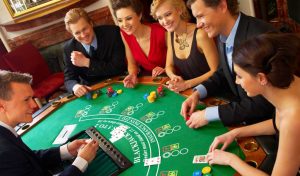
Black Jack Rules—Winning & Losing Hands
When the dealer concludes with a lower score than you and neither have exceeded 21, you win. If your scores are equal, you “push” (tie) and neither wins nor loses. If your score is less than the dealer’s score and he does not go over 21, you lose.
A “Blackjack” Hand
This is specified as two starting cards that have a total score of 21. This hand is also called a “natural” 21. Any two-card 21 carries a higher rank than a score of 21 achieved with three or more cards. Thus, if the dealer has 9-6-6=21, and you have K-A=21, you win. This rule forms one of the exceptions to a tie or push bet.
“Natural Blackjack”
- If you are dealt a natural 21, your bet pays off at a better rate than an ordinary winning bet. Almost all variations of the game pay out at a rate of 3-to-2 for a natural. This means that for a $10 bet, you make $15 rather than the usual $10. To phrase it differently, such a win pays out 150%.
What if The Dealer’s Up Card is an Ace?
Numerous rules come up when the dealer shows an Ace as his up card. Almost all game variations offer Even Money bets and Insurance bets. In very rare cases, some may also extend the Early Surrender rule.
Payouts & Types of Blackjack Bets — Black Jack Rules
Aside from your initial wager, there are several types of bets available when particular situations arise, each of which possesses its own unique payout ratio.
Insurance Bet
Virtually all games permit you to make an Insurance bet if the dealer shows an Ace. This opportunity arises after starting cards have been dealt. Also called side bets, insurance bets are placed to safeguard players against the dealer’s natural blackjack. Insurance allows a player to place another bet of up to one-half of his first bet. If the dealer has a natural, the insurance bets win at a rate of 2:1. Thus, a $5 insurance bet wins you $10.
Even Money
If you receive a blackjack hand and the dealer shows an Ace as his up card, the dealer might propose that you take Even Money for your hand. The dealer is proposing that you will accept a secure win at a lower payout rate (1:1 rather than the traditional 3:2). Nearly all gambling strategists recommend declining even money bets.
Early Surrender
Early Surrender, though rarely available, is another option that can be especially valuable when the dealer shows an Ace. Here, players may abandon their hand and relinquish only one one-half of their wager. Once all of the first choices have passed, the dealer reveals his hole card and players commence their actions.
Splitting Pairs
If you hold a paired hand, like two Fives or two Jacks or two Aces, you have the choice to split your pair. The universal convention for separating pairs is that the value of each card be an exact match for the other (suits are irrelevant). Two Tens form a precise match. Two Jacks form a precise match. A Ten and a Jack do not form a precise match, although each card is valued at 10 points.
How do you Split Pairs?
To split your pairs, place a bet equal to your initial wager by its side. If your first bet was $10, you must put down exactly $10 to split your pair. The dealer will separate your cards, forming two distinct hands, each of which now holds a unique bet and requires separate actions. Should you receive a blackjack after a Split Pair, the house will not recognize this as a natural and your hand will, therefore, be regarded as a lower value 21 when judged against another.
Double Down
Double Down is defined as duplicating your wager, and getting only one additional card. In order to Double Down, you place an extra wager on the table adjacent to your first wager for the same amount of money. The dealer will give you a single additional card for that hand, and you’re finished with that hand.
Late Surrender
In those casinos that offer late surrender, this is the point at which it is used; namely, after a dealer’s up Ace and hole card have been revealed to total less than 21. Before the dealer accepts additional card(s), players may surrender, losing only one-half of their wagers instead of the total amount. Those with two hands in play make two separate decisions regarding late surrender.
Taking Hits — Black Jack Rules
You have received your starting hand and assessed your options. It is now time to either hit or stand. Determine if your hand’s total score could be a winner as it is, or if you must attempt a better score. Remember, because the dealer must continue hitting until 17 or higher, his potential for busting with hands of 15 or 16 is great.
End of Game Payouts — Black Jack Rules
Once all players have received or declined cards and settled on their hands, the action returns to the dealer, who will reveal his hole card and either stand or take cards until he reaches a required total of 17 or more.
If the dealer’s score exceeds 21 (bust), all hands still in play win their bets. Whenever the dealer does not bust, each hand remaining is scored against the dealer’s hand. Whoever has a better total score wins, except in cases where there is a tie.
Practice! Practice! Practice! — Black Jack Rules
Now you know the rules. All that’s left to do is play. But before you put your hard-earned cash on the felt, test your skills with our free internet blackjack game. It’s free, it’s fun, and it provides you an opportunity to become familiar with the game’s setup and software, as well as test out your game rules reading comprehension.
After you have mastered online blackjack, play our other free online casino games. We love this game—don’t get us wrong—but there are plenty of other fun gambles waiting to be played. Good luck.
Online Blackjack Strategy
Player’s decisions as to whether or not to accept or discard cards and accept or decline a third card greatly influence the game’s outcome. Accepted strategy mandates that players never split 10’s, always split aces and 8’s, and hit until 17 when the dealer shows a 10. For more information on popular strategies and how to implement your own, click the below link.
Online blackjack, also known as 21, has long been a popular card game among both the land and online casino community. Part of its popularity results from the fact that blackjack strategy, unlike some casino games, requires informed decision-making and tactical thinking on the part of players who want to maximize their returns. Knowing the rules is one thing, but knowing how to win at blackjack online and casino games is another. Here, GamblingCity outlines a winning blackjack strategy and explains how to use which tactic and when.
Winning Blackjack Strategy—When to Split, Double Down or Just Give Up
Split: If a player’s first two cards have the same rank, the player can choose to make an additional bet and play as if each card is the start of a new hand.
A player can use this basic online blackjack strategy when his starting hand consists of pairs. Placing an equivalent bet next to your initial bet indicates to the dealer that you are splitting your pairs. When you split pairs you create an additional hand and the dealer issues cards for each hand.
A split bet is a good bet to make if a player has paired middle cards (sixes, sevens, eights), a bad bet if he has paired high cards (nines, tens) and a very smart bet with aces.
Double Down: For an additional bet, a player can take only one additional card.
For example, players employ this strategy with a starting hand of four-seven, for a total score of eleven. The player places an additional bet behind his cards, signaling to the dealer that he wants to double down. The dealer deals the next card, a queen, and places it across the top card. The player now has a total score of twenty-one.
Double down bets are best when the player’s starting hand totals ten or eleven and the dealer is showing a weak up card (four, five or six).
Surrender: This option allows the player to lose only half their original bet before seeing the dealer’s down card.
For example, a player has a total of fifteen and the dealer’s up card is a jack. If the player hits, he risks busting. If he stands, he risks losing to the dealer’s better hand. His best option is to surrender and only lose half his bet rather than risk losing it all.
Surrender is a way to “stop the bleeding” if the player’s weak hand runs into a dealer’s strong up card.
Insurance: If the dealer’s up card is an ace, the dealer will offer the chance to make an “insurance” bet of an amount up to half the original bet. The player wins the insurance bet only if the dealer’s starting hand is a “natural”.
The only time the insurance bet is a good bet for the player is if the player also has a “natural”. This bet insures that the player will at least get even money ($10 on a $10 bet) instead of a “push”. Otherwise, this online blackjack strategy is a losing proposition.
Winning Black Jack Strategy—Expert Black Jack Tips
Here are the best tips we know for winning blackjack:
- Play within your bankroll. Don’t overextend your gambling money to impress anybody or pretend you’re a high roller. You’ll have a lot more fun by playing within your roll and comfort level.
- Learn the basic strategy charts. Not only will you make the most profitable decisions every time, but you’ll also keep the game flowing smoothly. Don’t be that person who can’t decide if they want to hit on sixteen with the dealer showing an up card of nine; you’ll hold up the game for both the dealer and the other players.
- Keep your cool. The purpose of the game is to have fun; if you’re spending too much or if you’re angry at the dealer for pulling out a lucky card to beat you, step back, take a walk and go over your strategies again before jumping back into the pit.
- Tip the dealer. Most of the dealer’s income is earned in tips. One method to tip a dealer is to place a smaller bet alongside a larger bet and let the dealer know that the second bet is for him. If you lose, he keeps the tip. If the dealer wins, he keeps the tip and the winnings. While tipping doesn’t influence the cards, it might make the dealer more sympathetic to your troubles when you’re losing.
Follow the above tips and strategies to improve your game. The next time you play blackjack, you’ll likely walk away a winner.
Free Blackjack
Whether you’re new to the game, need to tighten your strategy or just want to play a risk-free hand or two, free games are a great way to practice without putting your bankroll on the line. Nearly all reputable online casinos host a free version that features the same crisp graphics and quick load times as their cash play counterparts. To play Gambling City’s free game or find others, click the below link.
Instructions:
To choose your free wager amount, click on the chip stacks in the lower right corner of the free online blackjack table. You may choose between $1, $5, $25 and $100 chips. Wagers are totaled per click. If, for example, you wish to bet $26, you may click $25 once and $1 once. Click “Deal” to receive your cards. After your cards are issued, you may Double, Hit or Stand.
Our flash blackjack game mirrors the games played in brick and mortar and online casinos almost exactly. Players bet before any cards are dealt and are in a contest against the dealer with every hand. Hand rankings and card values match those of standard game rules and bets cannot be decreased after the cards are dealt. Players may, however, employ “Double Down” and “Split” bets and may also purchase insurance, though not often recommended.
Strategy and the choices made by players when deciding to accept or decline a third card both affect the game’s outcome. Experts advise new players to learn blackjack basics: never split 10’s, always split aces and 8’s, and if the dealer shows 10, hit until you reach 17. The same strategies apply to our free blackjack game in flash.
Online Blackjack Odds
Put simply, this is a game of skill, and its mathematical underpinnings must be understood in order to win consistently. The house edge results from the fact that the dealer completes his hand after all others have revealed theirs. Bust and you lose regardless of whether the dealer busts as well. Thus, it’s crucial to know the probabilities of busting for each two-card hand. Read our odds page for this info and more.
When it comes to blackjack probability and odds equations, the first step a would-be casino online player should take is noting differences among online blackjack tables.
Figuring out how to win at blackjack is as much a matter of simple choices as it is advanced strategy. The first choice you will make is deciding at which table to take a seat. In fact, where you play blackjack is often as important as how you play.
Watch out for these differences among blackjack tables, as they will alter your blackjack probability and odds equations.
How to Win at Blackjack—Choosing the Right Table
Blackjack pays 6:5.
In a game with traditional blackjack odds, a “natural” pays 3:2 ($15 on a $10 bet). While 6:5 might look better, this setup only pays $12 on a $10 bet. If 6:5 tables are all you see, find a place that still offers 3:2.
Dealer hits on soft 17.
This rule improves the house’s blackjack odds and gives the dealer another chance to beat a player’s hand of eighteen or better. While this is not as egregious an advantage as 6:5 blackjacks, it is a rule that increases the house advantage by 0.22%.
No double down after splitting.
For example, a player starts with two sevens for a total of fourteen. The player splits his sevens, and then receives a three on the first hand and a four on the second. Now he has two hands, totaling ten and eleven, respectively. In a game with typical blackjack odds, the player would want to double down on those hands. The “No double down after splitting” rule cuts off this potentially profitable option.
| Total Hand Value | Odds of Busting on a Hit |
| 21 | 100% |
| 20 | 92% |
| 19 | 85% |
| 18 | 77% |
| 17 | 69% |
| 16 | 62% |
| 15 | 58% |
| 14 | 56% |
| 13 | 39% |
| 12 | 31% |
| 11 or Less | 0% |
Use this simple odds chart while practicing free blackjack games. Once you’ve memorized the odds, test your luck at the cash tables. Good luck.
Best Online Blackjack Tips
Most casino games have a set of suggested player actions when faced with a specific situation. Here, these actions are hard and fast rules. The good news is, these tips increase your odds of winning over time. The bad news is….well, there’s actually no bad news. Memorize a few simple tips and you’ll be on your way to winning.
Blackjack is one of the few casino games wherein a player can decrease the house edge if he plays carefully and sticks to a predetermined blackjack basic strategy. Online blackjack tips can tell players if it is preferable to hit or stand, split pairs, and/or double down.
Play online blackjack according to blackjack basic strategy, and you can avoid the urge to make impulsive bets.
Black Jack Tips—Hit or Stand
When you play blackjack, it all comes down to deciding if you should hit or stand. Memorizing when to take a hit based on the value of the cards that you already have is crucial. Let’s start by examining a few possible hands and working through them.
If you have a 9 or lower, always hit. There is a very low chance that you would be able to win with such a low hand, so taking a hit will always raise the odds of you winning.
You should also hit on any hand with a value between 10 and 16, but only if the dealer’s face up card is a 7 or higher
If you have a 17 or higher in your hand, stand. The chances are slim that you would be able to take a hit without busting. The best policy is to stick with 17 and hope that the dealer has a poor hand. This blackjack basic strategy, however, only applies to hard deals, when you do not have an Ace in your hand.
If you have an Ace in your hand, you have what is referred to as a soft total. Soft hands need to be played with a slightly different strategy because Aces can be ranked as either eleven or one.
The most common mistake made by players who ignore these casino and online blackjack tips is to stand on a soft 17, where the player has an Ace and a 6. While it is generally a good policy to stand on a hard 17, a soft 17 can be easily improved. Eight of the thirteen cards in a suit will be helpful. Even if the hit doesn’t raise the total, rarely does a hit on a soft 17 hurt it.
The above is true, in fact, with most soft hands. If you have a soft hand that is less than 19, take the hit. It can only improve your chances of walking away a winner.
Black Jack Tips—Tables to Avoid
After you have memorized the basic blackjack tips for when to take a hit, you can undertake a variety of other strategies for making your play both more enjoyable and profitable.
Most online blackjack players concur that one of the best online blackjack tips and a big blackjack help is to play in good company.
This is easiest to achieve in a casual home game among friends or at a game played in a casino online. But even if you are in a brick and mortar casino and cannot control who pulls up a chair after you, you can always decide to switch tables.
Avoid mean spirited or dejected players, as they bring down the tone of the table and steal your focus. The same applies to drunken players who have taken a little too heavy advantage of the free drinks offered at most casinos. They will distract you from your game.
Black Jack Tips—Maintaining Your Composure
Our final “blackjack help” tip? Don’t become one of the distracting players yourself, which means steering clear of the free booze and remaining emotionally detached from the game. When you feel that you are becoming too upset by your losses, take a break. Most casinos will allow the dealer to hold your seat while you do so.
Even if you just need to stretch your legs, getting away from the table for a few minutes will clear your head and keep you from taking the game too seriously and making costly mistakes.
Basic Blackjack History
Blackjack wasn’t always the popular game it is today and its origins are, like so many casino games, are not entirely certain. It’s speculated that the game, in its original form, was a combination of three other games; namely Baccarat, Seven-And-A-Half and Vingt-et-Un (21 in the Americas and Pontoon in Australia). How it made its way across the oceans, into land casinos and onto the web is an interesting tale. Our game history page tells it.
Casino blackjack games are among today’s most popular casino games and are available in nearly all land and online casinos. Basic blackjack has been played for centuries and its reach has spanned the globe. It is a game that requires mathematical knowledge, luck and courage. This unique combination appeals to players and has helped both casino blackjack and blackjack online achieve the widespread popularity they enjoy.
Still, the question remains: What is the history of casino blackjack and blackjack online?
Black Jack Game History—European Roots
Many historians set the beginnings of modern blackjack history in seventeenth-century Europe. It is believed that French players sat in the salons of noble lords and took part in a game called “vingt-et-un” (French for “twenty-one”). At the same time, legendary Spanish author Miguel de Cervantes, creator of the iconic characters Don Quixote and Sancho Panza, wrote a story about a great blackjack cheat and his sidekick, both of whom were skilled at the game of “veintiuna” (Spanish for “twenty-one”). Further east, a similar game called “sette e mezzo” (Italian for “seven and a half”) came into vogue among Italian nobility. In all of these cases, if the player’s hand exceeded the set value of 21, that player “busted” and lost his hand.
Blackjack Game History—Hello Vegas!
As with many modern card games, immigrants brought the basic blackjack game to the Americas. Blackjack, poker and faro flourished as explorers, entrepreneurs and gamblers made their way west.
In 1931, a small Nevada town, desperate for revenue during the Great Depression, made blackjack history when it legalized gambling and established the forerunners of modern casinos. That town was Las Vegas and the card game that attracted the most players was casino blackjack. In fact, the name “blackjack” came from a rule that allowed players to win ten times their original bet if their first two cards were an ace and jack of spades (a “black jack”).
Blackjack Game History—Counting Cards & Blackjack Charts
In 1962, a young mathematician named Edward O. Thorp employed a primitive digital computer to analyze typical blackjack hand distributions. Using his research and the computer simulations he programmed, he developed what casino and blackjack online players now call “basic blackjack strategy” and became one of the most prominent figures in modern blackjack history.
Thorp created early versions of the blackjack charts players use today to determine when they should hit, stand, split pairs and double down. He also pioneered the idea of “counting cards” by proposing that an observant player could track which cards had been dealt and change their bets according to the cards left in the deck. He published all of these findings in his groundbreaking book, Beat the Dealer.
Blackjack Game History—College Kids Master Blackjack Cheat Scheme
In the 1980s and 1990s, a group of students at the Massachusetts Institute of Technology (MIT) applied Thorp’s teachings when they created the infamous “MIT Blackjack Teams”. These groups employed basic blackjack strategy, counting cards, blackjack charts and team play to win millions from casinos all over the world. Their efforts were documented in the book “Breaking Vegas” and the hit movie “21”.
As a result of these card-counting schemes, casinos updated their blackjack policies.
In the mid-1990s, software developers began creating computerized blackjack games that could be played via the internet. Now, anyone with a computer, an internet connection and a credit card can play blackjack online at any time, day or night. These online blackjack games have taken the original version of the game to heights of popularity not previously seen in blackjack history.
Famous Blackjack Quotes
Blackjack is the only casino game an amateur can learn to play and at which he can definitely win. ~ Lawrence Revere, author, Playing Blackjack as a Business.
I love blackjack. But I’m not addicted to gambling. I’m addicted to sitting in a semi-circle. ~ Mitch Hedberg, comedian
I’m not into anything bad. Just blackjack. ~ Frankie Muniz, actor
Internet Blackjack Glossary
Blackjack is fairly easy-to-follow, as far as card games go. But as with any sport/game/activity, it comes equipped with a unique language that is entirely its own. Players hoping to beat the dealer must speak this language. Gambling City’s Blackjack Glossary can help. Click the link below and you’ll be “talking the talk” in no time.
For those of you who have just begun playing blackjack, Gambling City has developed a comprehensive online blackjack glossary to help you learn more about the terms that go with the game. Refer to this guide for blackjack definitions of unfamiliar terms.
Blackjack A to Z
21: A different name for the game of Blackjack. Also, the highest possible hand value in Blackjack.
5 (or 6 or 7) Card Charlie: 5 (or 6 or 7) cards with a total score of 21 or less.
Action: an all-purpose gambling term which denotes the entire sum of money wagered in a particular time period. Ten bets of $10 each makes $100 of action .
Anchorman: The player nearest the dealer’s right-hand side. This seat receives its cards last, just prior to the dealers receiving his. As a consequence, if you’re unaccustomed to Blackjack, you may wish to stay away from this seat. Some players will chide the anchorman for handing the dealer an advantage. If you do sit in the anchorman’s seat, follow the chart and don’t allow other players to get you off of your game. In fact, if you’re counting cards, this is the best seat. See Third Base.
Back Counting: Engaging in card counting though not dealt into the game. A counter who’s back counting typically holds off until a favorable time to enter the game. Casinos deter this practice by not permitting new players into the game until the dealer reshuffles the deck.
Back Line: A bet between players instead of between the player and the house. The players are called “back-liners” and the activity is known as “back-lining.” Many casinos dissuade this activity since the house does not see a profit.
Backing Up: Replaying a hand to establish the total score. If a player suggests the dealer has made an error, the dealer may exhume the hand from the discard tray, display the hand in questions and recalculate the score.
Bankroll: The money a player has set aside specifically for gambling. Within a playing session, this term typically refers to the amount of money a player puts in a game and not to the money in his wallet. Bankroll is occasionally used as a synonym for a player’s buy-in. The casino’s bankroll is the sum of chips in the dealer’s rack. Used as a verb, to “bankroll” a player is to supply them with cash with which to play.
Bar: To expel (blackball) a player from a game or a casino.
Basic Strategy: Simple casino and online blackjack tactics used by players to enhance their game performance and, ideally, increase winnings.
Betting Limits: The lowest and highest bets permitted by the casino at a particular game. When pertaining to a casino, this could concern the lowest and highest betting limits on hand at all casino games.
Blackjack: A hand composed of an Ace and a 10-value card (10, Jack, Queen or King) with a total score of 21. Generally pays off 3 to 2, with the exception of making such a hand with split Aces. Casino regulations deviate on the payoff on a Blackjack. A payoff of 3-2 translated to a $15 payoff on a $10; a $20 bet wins $30, etc. You’re receiving 1.5 times (150%) your successful bet, rather than the standard 1.0 (100%).
Break/Broke: Accepting cards (“hits”) and causing your score to exceed 21 points. See Bust.
Breaking Hand/Breakable Hand: A hand that can break (exceed 21) with a single card, e.g., a hard 16.
Burn Card(s):The first card(s) in a freshly shuffled deck (or shoe) that is (are) instantly placed in the discard rack before the first deal. Dealers rarely show burn cards to players. This move can impact the count if you are counting cards. If cards are dealt in the wrong order or uncovered, they could likewise be burned.
Bust/Busted: A blackjack hand whose value exceeds 21. This hand loses instantly. A player “busts” after “hitting” if the next card drives the player’s total score over 21.
Bust Hand: A hand with a total score of between 12 and 16 that can “bust” with another card. Also denotes a hand that will probably bust with another card.
Buy In: The sum of money (typically cash, but occasionally chips) with which a player sits down at a game.
Charlie: See 5 (or 6 or 7) Card Charlie.
Chip: A small plastic or fired clay disc applied rather than money for the purpose of betting. Chips normally occur in denominations of $1, $5, $25, $100, and $500.
Counting Cards / Card Counting: Blackjack card counting is a skill wherein a player maintains a precise mental record of the cards that have appeared during the course of a blackjack game. Blackjack card counting may provide players with a comparatively effective estimation of which cards are still in the shoe. Card counting is a scheme applied to increase the player’s advantage. The player ascribes “weights” to each card’s value and adds the card weights while the dealer turns each new card face up. The “count” can tell a player the most opportune time for entering the game. The player follows up on the count by making larger bets and/or devising modifications in playing schemes. While blackjack card counting is legal, numerous casinos will evict players caught in the act.
Counter: A player who uses card-counting techniques.
Cut: To divide the deck prior to the first deal.
Cut Card: A colored card, usually plastic, which the dealer gives to a player for the use of cutting the deck(s).
D9: Double Down bets allowed only on 9, 10 or 11 (hard hands only).
D10: Double Down bets allowed only on 10 or 11 (hard hands only).
Deal: To distribute the cards before a hand.
DOA (Double on Anything): Double Down bets allowed on any two cards.
Double After Splitting (DAS): Double Down bets allowed after splitting pairs.
Double Down: An action wherein a player may double his first bet and receive only one more card. No more additional cars can be dealt to that hand after Doubling Down. Double Down bets typically follow only a player’s starting cards. Yet, a few casinos permit players to Double Down after splitting a pair. Rare games let players Double Down with hands that have more than two cards. You may indicate this bet by plainly doubling your first bet. The dealer interprets this to mean that you would like to Double Down. In the event that you are Doubling Down on a pair that may be Split, you may be required to define out loud which option you are choosing.
Double Down Rescue: This action is allowed solely in non-regulation variants of Blackjack, such as Spanish 21. Double Down Rescue provides the option of returning the doubled part of the bet, giving up the other half, and finishing the hand. Analogous to surrendering.
Double Double Down: Allowed solely in non-regulation variants of Blackjack, such as Spanish 21. Double Double Down lets a player take additional cards after the first Double Down, by doubling the bet once more for another hit.
Double for Less:Doubling Down for less money than the first bet amount. Usually, when doubling is allowed, the player is not compelled to actually double his bet, but may add any amount equal to or less than (but not greater than) the original bet.
Double On Anything (DOA): Double Down bets allowed on any two cards.
Draw: Taking another card for your hand in order to get your score closer to 21, without going higher. See Hit.
Early Surrender: This rule allows players to surrender their hand even if the dealer has a Blackjack.
Even Money: This betting option is extended when the player has a Blackjack, and the dealer shows an Ace, presenting a possible Blackjack. Even Money implies that the dealer will pay your blackjack 1:1 rather than 3:2. It assures a win for the player, although at a lower payout than usual.
Face Card: A King, Queen or Jack. Also called a Picture Card or Paint Card.
Face Down Game: The dealer places your first card face up and your second card face down.
Face Up Game: The dealer places both of your cards face up.
First Base: The first seat at the Blackjack table, next to the dealer’s left hand. The player in this seat is the first to act on his or her hand.
Five Card Charlie: See 5 (or 6 or 7) Card Charlie.
Full No Peek: The dealer won’t look into their hand for a Blackjack until all players have acted, no matter the dealer’s up card. See also “No Peek” and “Peek”.
H17: Dealer is forced to take a card on Soft 17.
Hard Count: The true score of the hand.
Hard Doubling (HD): Double down bets allowed on first two cards if neither card is an Ace (hard hand).
Hard Hand: A hand with no an Ace, or a hand with an Ace that can only be scored as a 1. For instance, an Ace+5+8 can only be counted as 14. If you attempt to calculate the Ace as 11 rather than 1, the hand will have a total score 24 and will lose.
HC (Hole Card): See Hole Card.
HD (Hard Doubling): See Hard Doubling.
Head On (Heads Up):To play at a Blackjack table with only the dealer and no other players.
Hit/Hit Me: To call for additional cards in an effort to approach a score of 21 without exceeding it. The call is typically made by telling the dealer “hit me”, rapping your forefinger on the tabletop, or in the case of single-deck or double-deck blackjack, scratching the cards on the tabletop.
Hole Card: The face down card in front of the dealer.
Insurance: When the dealer shows An ace, you may make a side bet of up to half of your main bet. In doing so, you are wagering that the dealer has a Blackjack. Insurance bets pay off at 2:1. If the dealer doesn’t hold Blackjack, you lose the side bet, and finish out the rest of your hand as usual. If the dealer holds a Blackjack, your insurance bet pays out 2:1. The net result is that you break even, unless you also have a Blackjack. If you also hold a Blackjack, your hand ties the dealer’s. You hold on to your main bet and win 2:1 from the insurance bet, which is half of your main bet. The outcome is that your Blackjack wins 1:1, which is the same result as if you had chosen Even Money. For instance, your main bet is $20 and you place a $10 insurance bet. Both you and the dealer hold Blackjacks. Your $20 bet results in a tie, but you win 2:1 on the $10 insurance bet, for a total win of $20. $20 is a 1:1 payoff of $20. A standard Blackjack payoff of 3-2 would have won you $30. See also Payout Ratios.
Late Surrender: This rule allows Surrendering only after the dealer has looked at his hand for a blackjack. If dealer holds Blackjack, the player loses their full bet. If dealer doesn’t, the player loses half of his main bet.
Mid-Shoe Entry: Entering a blackjack game already in progress. In order to keep card counters from getting into a game when the cards turn in their favor, casinos will not permit mid-shoe entries. To put it another way, the players who want to get in the game will have to hold off until the dealer shuffles prior to their entry into the game.
Natural: When the first two cards a player receives give a total score of 21. Such a hand consists of an Ace and a 10-point card (10 or Face Card).
No Peek: The dealer will not look for Blackjack if his face up card is a Ten; occasionally “No Peek” means the dealer will also not look if his face up card is an Ace. See also “Full No Peek” and “Peek”.
Over/Under: A pre-deal side bet on a player’s starting cards totaling over or under 13, where aces are worth 1 point. Generally thought of as a losing bet unless the player is using card-counting schemes.
Pair: When the first two cards a player receives have the same rank. 5-5 is a pair. 9-9 is a pair. J-J is a pair. K-Q is NOT a pair.
Pat Hand: A starting hand with a total score of between 17 and 21. Pat hands are considered strong hands and players should “Stand” on these hands.
Payout Ratios: A normal win pays out at 1-1, Blackjack wins ordinarily pay out at 3-2, and insurance wins typically pay out at 2-1. For instance:
1-1 signifies that a $20 bet pays out $20. You win $20.
2-1 signifies that a $20 bet pays out $20. You win $40.
3-2 signifies that a $20 bet pays out $30. You win $30.
6-5 signifies that a $20 bet pays out $24. You win $24.
Peek: The dealer looks to see if he has Blackjack prior to the player’s decision to take more cards. This rule is advantageous for the player since it prevents him from splitting and doubling down (i.e. raising his bet only to learn that the dealer holds Blackjack). Variations of the Peek rule include allowing the dealer to look for Blackjack with an Ace showing and allowing him to look with either an Ace or 10 showing.
Push: A tie between the player and the dealer. The player neither wins nor loses money.
Rich Deck: A portion of a deck or shoe with a remarkably high number of ten point value cards and Aces.
RSA: Re-splitting of Aces is allowed. This is a rare rule that is advantageous to players.
S17: Dealer is forced to stand on all 17s, soft or hard.
Scare Card: A high-value (ten or ace) up card in front of the dealer.
Scratch: To request a hit. Also, the act of scratching a card on the tabletop to request a card. Used in single-deck and double-deck blackjack.
SD (Soft Doubling): See Soft Doubling.
Second Base: The seat directly across from the dealer.
Settlement: The payoff of winning bets at the conclusion of a hand. Either the dealer scoops away your chips, pays you your winning, or in the instance of a push, taps the table and leaves the chips alone.
Seven Card Charlie: See 5 (or 6 or 7) Card Charlie.
Shoe: A box (typically made of wood or plastic) that contains up to eight decks of cards, and lets the dealer slip out one card at a time; usually applied in multi-deck games.
Shuffle: The operation of randomizing the cards, normally handled by cutting and thumbing through the deck.
Single Deck: A blackjack game using only one deck of cards.
Six Card Charlie: See 5 (or 6 or 7) Card Charlie.
Soft Doubling (SD): Double down bets allowed on soft hands.
SME10: Only tens of the same rank can be split. For instance, K-K can be split, but splitting K-Q is not allowed.
Soft Hand: A hand with an ace that can be valued as either a 1 or an 11. For instance, an Ace+4 can be scored as 5 or 15. The 15 is thought of as a “soft” 15, since if you were to take another card and it came up a 10, you will not go over 21. In that case, your score would be a “hard” 15.
Ace+4 = soft 15 (the Ace can be a 1 or 11 without going past 21)
Ace+4+10 = hard 15 (the Ace only counts as a 1, or else you’ve gone past 21)
Spanish Deck: A deck of 48 cards. Same as the standard deck, but with no tens. A Spanish deck has 2s through 9s, Jacks, Queens, Kings, and Aces, but no Tens.
SPLIT3: You may split pairs up to three times.
Split Hand: See Splitting Pairs.
Splitting Pairs: This occurs when a player’s first two cards have the same rank, and the player opts to break up the pair, producing two separate hands. 6-6 is a pair. 9-9 is a pair. K-K is a pair. K-Q is NOT typically thought of as a pair. Once you split a pair, you put down a new bet to the second hand, the same amount of money as the first bet. You play each hand separately, one after the other. The call to split pairs is typically made by plainly duplicating the bet. The dealer interprets this to mean that you would like to Split the pair. Split Aces are typically allowed a single additional card each.
Spread: Putting down multiple bets prior to the first deal. For instance, a player may place three bets and receive three separate hands to play.
Spread the Deck: To place the cards face up on the tabletop, dispersed so that potential players could look at them to insure that the decks are whole. This practice is usually performed when a new table is opened up.
Stake: A player’s gambling money, the money the player puts down on the table. See Bankroll.
Stand: A signal that the player is content with his hand and doesn’t need any additional cards. The signal is normally made with a sweeping movement of your hand, palm facing downward. In a single-deck or double-deck game, placing the cards on the table with your bet resting on your cards makes the signal.
Stay: See Stand.
Stiff: A hand that could potentially get a total score over 21 (bust) by taking an extra card. For instance, a hard hand with a total score between 12 and 16 points is a stiff. Stiffs carry lower odds of winning no matter how you play the hand. See Bust Hand.
Suit: One of the four types of decorations on cards – Clubs, Diamonds, Hearts and Spades. Suits are irrelevant to hand values in blackjack.
Suited Blackjack: A Blackjack wherein the Ace and 10-value card are of the same suit. These hands do not carry any extra value and do not win or lose any additional bets.
Surrender: In a few casinos, the player is permitted to give up one-half of his primary bet if he doesn’t wish to bet against the dealer’s hand. This rule is processed prior to asking for additional cards. For instance, the player bets $20 and receives a 7 and an 8 card for a total score of 15. The dealer shows a King. If the player “surrenders”, the dealer will take back the player’s hand and half of the player’s primary bet. The player is left with $10. The player has given up half his bet, and not acted on his hand. He is taking for granted that his hand is a loser, and opts to lose merely half the bet. This rule is not on hand in all casinos.
Early Surrender– The choice to surrender prior to the dealer’s verification of his Blackjack.
Late Surrender– The choice to surrender only after the dealer’s verification of his Blackjack. If the dealer holds a Blackjack, the choice to surrender is not provided.
Third Base: The final seat at the Blackjack table, next to the dealer’s right hand. The player in this seat is the last to act on their hand. Also called Anchor or Hot Corner.
Twenty-One: A different name for Blackjack.
Up Card: The card face up in front of the dealer. Players usually factor the dealer’s up card into their decisions to hit or stand.
We hope you found this collection of online blackjack terms helpful and will better understand the action the next time you are playing blackjack. As always, have fun, play smart and win big!
Game Summary
The advent of the online casino, which made remote play possible and provided a quick, convenient way to slip in a game or two without the hassle of travel, invited a younger, tech-savvy generation to its players club.
Hollywood also contributed to the game’s allure. 2008’s ‘21’, which chronicled a card counting scheme that turned a group of MIT math whizzes into millionaires, captured the imagination of younger players and, undoubtedly, increased its fan base.
But more popularity means more competition, both in terms of the number of players and the vast array of online casinos from which to choose. And more competition means a greater need for knowledge, which is where Gambling City comes in.
While it is true that the game’s house edge is generally lower than it is in other casino card games, the chances of winning consistently are only as good as your understanding of its rules and your employment of a solid strategy. We provide both and throw in comprehensive articles on blackjack tips, history and terminology, so you’re equipped to win.
Our online casino reviews tell you which leading gambling hot spots offer blackjack online and a free practice game, and assess everything from payout percentages to where to find the most well-attended games. Gambling City editors actually play in the casinos they evaluate, so you can rest assured you’re reading an unbiased review.
The above summaries each address an aspect of the game you should familiarize yourself with before playing. Simply click on the links provided and let the betting begin.